Microsoft Dynamics Technical Conference, 2016 / Day 1 Session 3

Microsoft Dynamics Technical Conference, 2016 / Day 1 Session 3

My report from the technical conference.


Our third session on opening day, Tuesday February 23, 2016 was our first breakout session. I chose “Development Application Lifecycle Management (ALM): Setting up build and test automation” by Shailesh Nikam, Senior Program Manager.


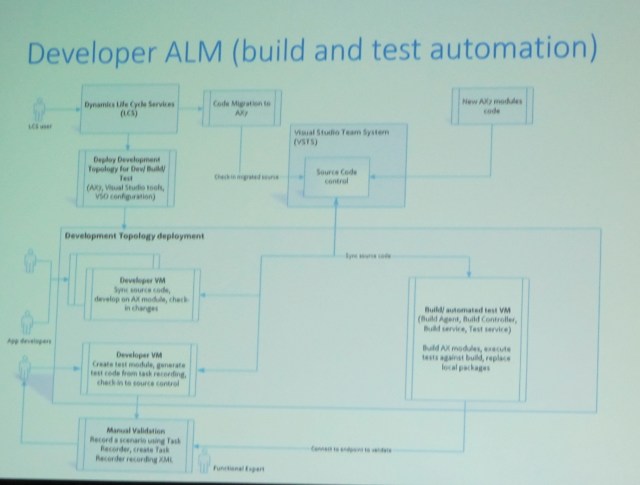
Developer ALM – hope the photo is clear enough – is tied in with source control. There is a build VM. Task recording creates an XML file and can be used to generate a test. This enables us to do essentially continuous validation, or what we used to call regression testing.
 

IMG_2095


The capabilities of build and test automation in AX7 are: developer topology deployment from LCS, build orchestration, and testability. There is a long list of sub-details, which you will see if you check out the system on CustomerSource or DLP, but I want to point out that using Visual Studio Team System, we can now have LCS discover and build AX models. Similar to everything else in the new AX, it is XML based. You can customize the MSBUILD tasks, so it’s got a default yet is as flexible as you need. Gloriously, we can auto-generate test code from task recordings.


Developer topology deployment – LCS: you choose DevTest option for cloud deployment, choose the dev and build VM configuration, can update custom settings for build agent and branches. Visual Studio Team System integrates and auto-configures the build VM.


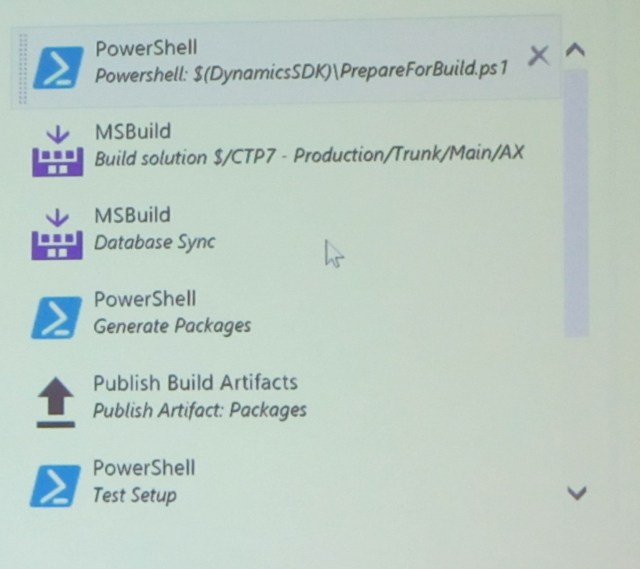
Visual Studio Team System – build orchestration. One highlight here is that you have extensibility using PowerShell. Again, you can customize the build order, and select the modules and projects to build. This enables the creation of both a deployable and a source package and the upload of build artifacts to VSTS for release management.
 

IMG_2098


Testability. We can use the SysTest framework to author unit and component tests, set up a custom data set for validation and automated tests, auto-generate test code from task recordings, and report on the execution via either the VSTS web interface or the Visual Studio IDE.


We then had a demo.

  1. Deploy developer and build VM from LCS. You select the environment topology: Azure or locally (a vhd). You go to project settings in Visual Studio Team Services and connect up the machine and VS). There should be a 1:1 mapping of the LCS project to a VSTS project. It takes about 4 hours to deploy.
  2. Create test code from task recorder. In Visual Studio you import the task recording. Look at the code and the test attribute: SysCodeGenAttribute(), SysTestMethodAttribute(). You can add build steps (PowerShell, sync, report deploy, generate packages, publish artifact packages, test setup, execute tests, test end, publish artifact, additional logs.
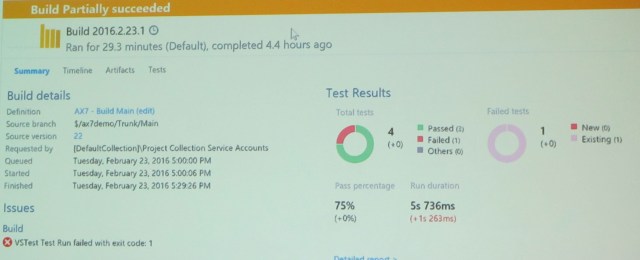
  3. Reporting on VSTS web interface and within desktop Visual Studio. It tells you how many tests passed and failed, and you can drill into the failures.
 

IMG_2101


Moving ahead: we are looking at updating the wiki, having better cost effective options for cloud dev to build, dev/build/test as a service, and much, much more… Microsoft is soliciting feedback to see what features YOU would like to see in this.


All of the above is open source, to boot.


There were lots and lots of questions. I’ll recap just a few here. If you have a bad test, you must redo them all, unless you disable specific tests. You can turn best practice checks on or off. Testing can be run locally, too, so that you can check it BEFORE you build it. J Task recorder is not very resilient when you have field name changes. You need consistent test data between environments. Custom fields break test scripts. You don’t really want Microsoft’s test scripts because of quantity and data dependence. The build is quicker because it’s just a partial build (four hours is now sixteen minutes). Scalability is still an open question.


I hope this “just the facts, ma’am” note from the session does not mask how enthusiastic I am and we should all be for this automated testing. It’s a far, far cry from earlier versions, and finally legitimizes the bastard testing child. This should become de rigeur in every product and implementation!


I hope you have enjoyed this post. I am now heading home from the conference (bummer), but will of course continue to update on each session!


Happy DAXing!


Posted in ax 7, AX7, Dynamics AX | Tagged , | Leave a comment

Microsoft Dynamics Technical Conference, 2016 / Day 1 Session 2

Microsoft Dynamics Technical Conference, 2016 / Day 1 Session 2

My next report from the technical conference.


Our second session on opening day, Tuesday February 23, 2016 was another general IMG_2083session. This one by another crowd favorite Sri Srinivasan, General Manager, Dynamics AX Platform R&D.
 

Today, Sri was all about the cloud. Sri talked about how the new Microsoft Dynamics AX maximizes the cloud. This wasn’t just a major release, it was a major release! 🙂 He recapped our journey from when Microsoft purchased the software, till now, and the additions/focuses of the versions:

Our Journey

2002 – Axapta 3.0

2006 – Dynamics AX 4.0. Platform built on delivering scale and reliability

2008 – Dynamics AX 2009. Platform scale and expanded industry footprint

2011 – Dynamics AX 2012. Built for industry, differentiated application lifecycle management through lifecycle services

2016 – Dynamics AX. Powered by Azure Cloud.


He explained how AX is now a complete solution (immersive experience, web based client, global industries, and azure cloud enabled) and has change management (integration platform, application lifecycle exp., developer experience, continuous update). In fact, the update will be like none before, and can truly be all but continuous. This is a big improvement over scheduling updates months in advance. Gone are the days of having a binder on how to perform a task in AX.


He demonstrated lifecycle services, and how the asset library enables us to deploy not just code but also data from it.


He demonstrated import, showing how we have a “recent” area where we can quick click to our more recent forms. We saw how movable help followed the cursor. We can filter a form, then add it to our workspace. We can even pin it to the dashboard.


Dynamics AX’s differentiated capabilities are:

  • Change management (user training)
  • Data governance
  • Complete solution


Sri then gave us many more details on how the cloud is going to work. It seems MS has shifted from a time-based payment to a user based subscription. A relief for those of us who went crazy to shut down the machines at night! We can have automatic provisioning, all sorts of Azure software, we can scale, we have application lifecycle management, servicing is easier, MS manages our cloud, and we have an enhanced upgrade/update. All thanks to the cloud.

How does the AX cloud differentiate?

  • Simple user based subscription
  • Customer’s choice
  • Deployment choice
  • Packaged solution


Visual Studio has tools for us to use. The client is HTML5 running on a Windows universal app, iOS, Android. The app is AX, of course, and the data is Power BI, SSRS, SQL, Blobs, DocDBs.


Sri went over the LCS solutions and the ones on the Azure marketplace, and noted that we are the only ERP with 50 solutions on ship date! Just imagine not having to install ISVs!


He then discussed our capabilities beyond this week’s RTW – what they’re planning for the future. And as far as we’ve come, it seems we’ve only touched the tip of the iceberg.


There was discussion of the Dynamics AX entity store and PowerBI, and how you can create new measures on the fly. A PowerBI license will be included with AX.


Finally, Sri showed us the Dynamics AX Roadmap. I won’t publish it here, since I don’t know if OK, but I would be surprised if it’s not on twitter already. The expectation is that we will have an on-premise/private cloud this fall, along with data upgrade. UIs and UAs will also keep coming. Microsoft asks for us to reach out to them on ways to improve the product.


And that was only the second of five sessions on the first day! The punchline here, besides what I’ve already mentioned, is that MS is eager to responsive to customers’ needs.


Happy DAXing!


Posted in ax 7, AX7, Dynamics AX | 1 Comment

Microsoft Dynamics Technical Conference, 2016 / Day 1 Session 1

A report from the Emerald City, where despite the fact that the weather was “mostly sunny” today, the talk of the town is the new Dynamics AX. While it’s my habit to provide a daily report, I only was able to type up notes from the first of five sessions today, so will publish that one, rather than wait for the full day’s report. I know everyone is on the edge of their seat to hear about (what MVP Lane Swenka quoted Sri Srinivasan as) a sexy ERP.


A couple of conference notes. While CRM was part of last year’s conference, it is not this year. And despite the fact that it’s billed as a technical conference, there are a LOT of functional sessions. Attendance is at a record 1375.


Our first session today was a general session with Daniel Brown, general manager of Microsoft Dynamics AX research & development. He IMG_2069certainly did a great job revving the crowd. The focus is “Business Process Transformation and the new Dynamics AX”. You will see a recurring theme on how the new AX is focused on the business, and how it can be better for the businesses, rather than how business can adapt to their ERP.
 

The huge announcement was that yesterday (Monday), we shipped the new Microsoft Dynamics AX! It is now in General Availability, or what’s now called RTW (released to world? Corrected: release to web. Thanks to Bertrand Caillet!).


A great way to summarized the drastic changes to the system is to copy the bullet points that Dan provided to us:


What is it?

– Intelligent user interface

– Proven business logic

– Continuous life to your system

– Business anytime, anywhere


He went into details on how much better the user experience is. We are certainly cloud first, mobile first. Dan did a demo for us and at the end revealed that he had done it all on his smartphone. He discussed business process reinvention tailored for the particular employees and their roles, or personas. Business process insight integrates exciting new changes in PowerBI – which he did not discuss in detail, but I have seen elsewhere that there are big changes – circling around real time analytical data. We can also take action based on the insight that is provided. It’s well integrated with Office including import and export. Data management is done via data entities – there are now 1700 of them. Possibly a tenfold increase from the version you are currently on!


Cross-company data entry is quite different now.


Data entry, in fact, has changed. You can create a general journal in AX, and open it in excel. It has a shipped template thanks to the data entities. You can enter data in Excel, where the user might be more comfortable, and then publish it back to AX.


Globalization is another area which has undergone drastic transformation. In days past, a V.0 would ship with few localizations and they would catch up later. Not now. We have a UI in 40 languages, a UA (help) in 17 languages, and regulatory reporting for 16 countries. Many more of each are on the way. Localization is configurable. There are curated solutions available for this, which meet a “very high bar.”


Agility is another hot topic. We are working much more granularly now, in that developers can do component level work, and we can more precisely service the ERP.


Lifecycle, ah, everyone has heard talk about that by now. Deploying code via the cloud? Unattended deployments done automatically via builds which can be customized? Step right up, folks, and prepare to be amazed… Help is now Wiki-based and task recordings, well, they’ve now got capabilities you’ve never dreamed of. In short, cycle time is much less.


Over 70 ISVs with 130 solutions were in the onboarding process, with 48 curated solutions, and 45 of them in the Azure Gallery. Though I heard on twitter that we actually had a few more than that. When have we ever released a V.0 with dozens of ISV solutions ready on GA day?


Quality has not been neglected in the looking forward. There are huge strides made with automated testing, to support a “Zero Bug Backlog” which translates to reduced time of open bugs. Multiple previews were delivered in a very large TAP to ensure quality.


Nine or ten companies have already gone live with the software. Several more on the way.


There are some deprecated items; however, a head was in the way of them when I took my photo of the slide (sorry). I can tell you that Advanced WMS takes the place of WMS II.


Finally we had our call to action: to learn about business processes at the technical conference. I will paste here the areas and their number of sessions so you can judge the focus.


– Horizontal

  • Financials (19)
  • Human resources (3)
  • Project management (3)
  • Supply chain (26)

– Industry

  • Manufacturing (7)
  • Public sector (2)
  • Retail (12)
  • Service industries (1)

– Process Tech

  • Business intelligence (5)
  • Integration (1)
  • Office (2)
  • Performance (2)
  • Support (1)
  • User experience (3)
  • Workspace (3)

– Types of Courses

  • Ask the Experts (7)
  • Breakout sessions (59)
  • Hands-on labs (8)
  • Round table/focus groups (16)

Please enjoy, and thank you for your patience in seeing about the other sessions!


Happy DAXing!

Posted in ax 7, AX7, Dynamics AX | Tagged , , | 3 Comments

Microsoft Dynamics Technical Conference

I expect you all have heard by now about the technical conference, coming up fast! I want to note some key points:

  • Focus will be on the new version, informally called AX ‘7’, which is currently scheduled for release soon after the conference.
  • Scope is strictly AX – no CRM like last year.
  • Schedule is out at https://www.microsoft.com/en-us/dynamics/techconference/Session-Catalog.aspx . Use the schedule builder to maximize your time. I had a devil of a time choosing between the offerings at times! Two speakers I practically worship go on at the same time; I am anguished!
  • Fun to be had, outside of the conference, include the Living Computer Museum (check their hours before heading over there). It is a well-kept secret which should not be.

Before and after training are available.


So, how important is this, you ask? My answer: very. When it looked like my company would not have the budget for me to go, I paid for my own registration, requested vacation days, and booked flights with points. And I’m glad I did, because I’m hearing from colleagues that people, who very much wanted to go, are not getting the opportunity. I realize that not everybody can do this, but if you can, then do! Hope to see you there!

TechConf2016


Happy DAXing!

Posted in ax 7, AX7, Dynamics AX | Tagged , , | Leave a comment

Adapting to the Changing AX Landscape

This is my tenth year in Axapta/AX and either I didn’t used to pay attention, or the landscape is changing more drastically than ever before.


Economic difficulties, some new and some residual from a decade ago, are forcing companies to redefine themselves and their missions. A quick glance at owler.com tells me that just in the past few months, Microsoft has acquired UC Commander, Hitachi has acquired Ignify, UXC Eclipse NZ acquired AX and BI from Koorb, Infosys acquired oil and gas consultant Noah Consulting, and based on rumors, speculation, and the economic indicators, there are more on the horizon.


Microsoft is offering its new version of Dynamics AX in “cloud-only” mode initially. Partners who wish to provide solutions must deliver to and document in Azure.


What’s more, the trend in recent years has been for customers to get much more sophisticated than ever before. Witness the interactions in the forums at AXUG. End users are watching and learning, and taking the reins.


What is one to do? I’ve been asked this by colleagues – of course, as a casualty I might not be your best judge – but I might also have some hindsight.


  • Skill up. My dad’s lifelong lesson to me was “Keep your options open.” Your new skill may be useful at a new position, or it might show the world that you are willing and eager to learn and be flexible as needed.
  • Network. I did not realize until recently just how much of the industry I had covered in my network. LinkedIn is a lifeline here (though not the only one). This is not just useful in job searching (though very much so), but also in gaining a different perspective of the business. p.s. #DynTech2016 is an excellent opportunity here.
  • Be flexible. Try different methodologies. Consider traveling vs commuting vs remote. Play with a new module, or BI, or integration.
  • Contribute. Perhaps you have a suggestion for a question asked on a forum. Or a comment on a blog. You don’t need to start big, just start getting out there.


Have more? I’m sure I’ve missed some. Please comment below!


Happy DAXing!

LogoEvolution

Posted in Dynamics AX | Leave a comment

Passed Exam MB6-890 Microsoft Dynamics AX Development Introduction!

It’s been a very eventful few months, hope that you all are keeping up on the many AX happenings! I have so much to update but in the interest of not appearing ADD I will keep this post to the one topic of the exam.


As you may have read in an earlier blog post, I was asked to consult on the creation of the development exam for the newest version of AX, then called AX ‘7’, now simply “Microsoft Dynamics AX” [though I suspect it will be AX ‘7’ informally for quite a while more]. I was under a NDA and did not disclose much about it.


Now I can say that I simply advised on the topics they were considering. How often they were used and how critical they were to the job. I had no knowledge of any of the actual questions.


The exam was released last month, much earlier than I’d expected, and before I knew it, the holidays were here and it was the new year.


Two things converged to make me decide to sit for the exam. First, it is time for a job change, and certification certainly helps to make one marketable. It shows potential employers that yes, you may have been in the AX space for a decade, but you are still keeping fresh on the latest happenings. Second, what I had seen of the topics they were considering made me optimistic that they would be fair and balanced.


I sat for the exam Tuesday. I chose that day only because it was the last possible day to take the exam and get a free Second Shot. 🙂 I’m so pleased to report that I do not need the second shot.


Judging by the twitter chatter, there are few who have dared this yet. Many have asked me about preparation for the exam. Please view the exam description at Microsoft Learning and note that Self-paced training refers you to the Dynamics Learning Portal. This is the first time that I recall, where training was strictly in video form – no books I could download – I really suffered from that – love my books!


I am happy to report that I feel the DLP prepared me very well for the exam. I feel that anyone who studies the videos will be able to pass the exam. Note: Rob Hensley warns us of an error in the video.


So don’t be shy, give it a shot – certify!


EDIT: I did note three questions which were unclear or misleading, and gave feedback on them in the space available.


Happy DAXing!

congratsmb6890


Posted in AX7, Dynamics AX | 7 Comments

MB6-890 Dynamics AX7 (Development) Exam

I was privileged to be asked to consult on developing the technical exam for the next version of AX. They called it MB6-890 Dynamics AX7 Exam. I referred a friend, also, who asked how I got onto their list. I don’t really know – got on the right person’s radar, I guess. At any rate, we have been working towards the next version, and in fact spent last week in Bellevue learning to upgrade. That’s for another blog.


My employer gladly issued a limited release (thank you!) so that I could work on this project. I am honored and flattered to be part of it. I can’t disclose details, of course, but I will say that if you have been paying attention to know that Visual Studio is coming up front and center, and if you have taken any previous development exams, then you know what topics are being considered for this exam.


In short, I saw no ugly surprises, and everything is as expected of a high quality exam like the AX technical exams have been.


EDIT: I did note three questions which I found unclear or misleading, and gave feedback on them.


Happy DAXing!

Posted in AX7, Cloud, Dynamics AX | Tagged , , , | 4 Comments

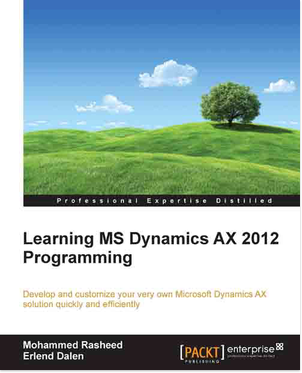
Book Review: Learning MS Dynamics AX 2012 Programming

I recently read Learning MS Dynamics AX 2012 Programming, by Mohammed Rasheed and Erlend Dalen, published 2014 by Packt Publishing, and wanted to share my thoughts with you.

First, the basics. Dalen has published before (Microsoft Dynamics AX 2009 Programming: Getting Started), whereas this appears to be Rasheed’s first foray into authoring. The chapters in this book are organized as follows:

Chapter 1: Understanding Dynamics AX 2012Learning MS Dynamics AX 2012 Programming
Chapter 2: The X++ Language
Chapter 3: Storing Data
Chapter 4: Data User Interaction
Chapter 5: Searching for Data
Chapter 6: Manipulating Data
Chapter 7: Integrating Data
Chapter 8: Integrating with Standard AX
Chapter 9: Creating a New Module
Chapter 10: Working with .NET and AX
Chapter 11: Web Services
Chapter 12: Enterprise Portal
Appendix A: Links
Appendix B: Debugger

Target audience: “This book is for developers who are new to Microsoft Dynamics AX and consultants who know the functional side of AX, but would like to learn how AX works behind the scenes. Experienced AX developers might also pick up some good pointers here and there.” The book definitely assumes prior knowledge of object-oriented programming; if you are starting in AX development and not familiar with OOP principles, please check them out first.

R3: As this book is so recently published (Dec 2014), I would have liked to have seen it be about R3; but it’s not (example: “The Application Object Tree (AOT) is where you find all code elements in AX”). R3 is acknowledged. In addition, the links include InformationSource, which was decommissioned prior to the book’s publication.

Pros: The chapters flowed well, both within and between. There is a lot of good discussion about best practices, which is important to start with and should not be a later add-on. There is a superb reference in Chapter 2, which any developer should bookmark for later. There are good code examples; for instance, a form splitter. The Integrating Data chapter discusses TextIO, XMLWriter, ODBC etc. which are not usually found in a beginner book but very useful. The selling point of the standard AX chapter is its discussion of inventory dimensions – this is key to AX 2012. I appreciated the chapter on creating a new module, as this material is not often covered. The .NET chapter is one that I personally plan to go back to and study; as an old-timer in AX since version 3.0, I need to “fresh up” on the newer technologies.

Cons: I found Chapter 1 to be confusing; I would not want it to be my first exposure to AX. The book is sorely lacking in SDK links (the SDK in general is linked in the appendix, but topical relevant links within the text would be much appreciated). There is not too much explanation of why you do things; just the statement that you do.

Recommendation: If you are new to developing in AX, and are working in 2012, especially RTM, this is a good book to purchase and keep on your (virtual) bookshelf. If you have experience, then weigh the chapters above. With intermediate level developers, the chapter two reference probably makes it for you. With more advanced developers, consider if you want to study inventory dimensions, new modules, or .NET – if so, this is likely to be something you’ll want. Personally, I would buy it, as it is a value add to my AX book collection.

Disclaimer: I was given a free e-copy of the book for review, and have strived to do a fair and impartial one. I thank the publishers for their consideration.

To buy it: It can be purchased at http://bit.ly/LearningMS

Happy DAXing!

Posted in Dynamics AX | Tagged , | 1 Comment

New Lean blog post: Lean by the Numbers: A Quantitative Understanding

Hello world!


I wanted to interrupt my regularly scheduled technical conference commenting to highlight a new blog post. My colleague, Lean Manufacturing expert Phil Coy, has published a blog post called Lean by the Numbers: A Quantitative Understanding. It reflects on his experience at the recent Association for Manufacturing Excellence (AME) conference in Toronto. He reflects on the Manufacturing conference much like I’ve been for the Dynamics technical conference. If you’re interested in manufacturing, do make sure to get Phil’s take – I find him very insightful.


Enjoy the blog!


Experts By Association: Guest Blog Lean by the Numbers: A Quantitative Understanding

https://www.dynamicscafe.com/2014/01/27/experts-by-association-guest-blog-lean-by-the-numbers-a-quantitative-understanding-2/


Happy DAXing!


Posted in AX2012, Dynamics AX, Lean | Tagged , , | Leave a comment

Microsoft Dynamics Technical Conference 2015, Day 3 report

Hello world!

If you did not attend #DynTech2015 may I say you missed a great thing. But you knew that already. You are here to read about the sessions. So please accept this, my report from the trenches, for Day 3, the last day of the first AX/CRM technical conference.

Microsoft Dynamics AX on Azure: Deploying Microsoft Dynamics AX in the cloud to run all aspects of your business: the speakers were Ryan Battle (cloud) and Christian Wolfe (performance). We got a good sell on the Cloud in this session. 🙂 The Cloud is the Future is the repeating message. They discussed the different hardware available for Azure environments: A series, which is “not really a factor anymore”, D series, which uses SSD’s and has faster CPUs, and prices from USD$236-$980/mo, and G Series, which can go as high as 32 cores and 448 RAM, for a range of USD$454-6532, which they say would be good for production environments. I personally know that Microsoft has worked with real customers and their partners to get good response time going, but haven’t seen a go-live yet. Your options for deploying in Windows Azure are Lifecycle Services, manual setup, and build your own (of course they prefer the first, and they will explain why). They demo’ed setting up an environment and changing the topology. In addition, you can customize with Hybrid Networks. A gotcha is that when you specify the accounts, they do not validate them at the time – a bad account means you will get a failure further down the road. Finally, they addressed performance issues, and optimizations that you can do.

Programming .NET with Microsoft Dynamics AX: I have discovered a second speaker whom I must seek out whenever I attend a conference: Peter Villadsen. Knows his stuff, and very entertaining. He gave us several examples of “how to leverage .NET from within the Microsoft Dynamics AX development space.” This was certainly a level 300 class as advertised, but a teaser of marvelous possibilities for those of us not quite there. He discusses the common language runtime (CLR), calls to .NET using reflection, managed controls to achieve a richer user interface experience, and the business connector – note that in AX6 (AX 2012) it was completely rewritten, and now has a user interface. He explained the benefits of offering business logic. To my delight, his first demo was “Hello world” with the basic business connector (thus the opening to this blog is a tribute to him). It was quite pleasing to see so many demos with code and watching them run and do useful AX things. He’s also the first speaker I’ve seen discuss idempotency (guess what autocorrect suggested? I mean, really, Microsoft!) – a so very important concept! (Or did I lead a sheltered life?) Two important conclusions he pointed out: 1) The BC should be used only for cases where business logic must be implemented in C# and 2) You should consider using services instead for all non-business logic related scenarios. Then, he discussed using services. He used the Hanoi puzzle (which I do not recall learning years ago in college or graduate school) and showed how to solve it in X++ and P-Code, demonstrating the differences in performance. Another demo (can you see he used well known ones?) was the travelling salesman. This can be applied particularly well to our customers who ship and need to load and run trucks optimally. As a finale, we watched him attach the Spark Core (a USD$19 Wi-Fi enabled chip) to a phone to measure the temperature and report it in AX. Please watch this, it was very cool, and only “three lines of code.” His blog is at http://blogs.msdn.com/b/x/ but unless I’m missing something, I don’t see anything recent. I urge you to make sure you view this session when it is available online.

Ask the Experts: TFS integrations and deployment of customizations: My last two sessions were both “Ask the Experts” with less structure and format, so forgive if the notes seem disorganized. Ian Beck, Liang Yu, and Robert Badawy were there to “answer questions related to best practices around version control (TFS) integration with Microsoft Dynamics AX and deployment of models to testing, staging and production environments.” There were not many TFS changes since the last conference, and not much they could say about the next version. While their focus will be on AX ‘7’, they will do bug fixes in AX 2012. It could be very simple to migrate from TFS on premises to TFS online, and Microsoft has released a tool for it; you might simply update a URL (my understanding is this would be in the VC parameters screen). Note that TFS was tested and validated in R3. It “should” work in R2 but they are NOT doing any testing nor bug fixes there. There are general TFS best practices, but not specifically for AX/MorphX. We still have the same difficulties with private boxes; while it is technically possible. They mentioned a white paper which I believe is the one at http://www.microsoft.com/download/en/confirmation.aspx?id=26919 Microsoft Dynamics AX 2012 White Paper: Developing Solutions in a Shared AOS Development Environment. Other white papers mentioned include: Change management and TFS integration for multi-developer projects http://go.microsoft.com/fwlink/?LinkId=264935 and Deploying customizations across Microsoft Dynamics AX 2012 environments http://www.microsoft.com/en-us/download/details.aspx?id=26571 . They don’t support shelving, nor do they recommend using xpo’s. You should have a build process (may I recommend you search for blogs on this; in particular How We Manage Development – Automated Builds http://community.dynamics.com/ax/b/daxmusings/archive/2014/01/09/how-we-manage-development-automated-builds.aspx ).

Ask the Experts: Microsoft Dynamics AX development tools on Visual Studio 2013 was my final session before the doors closed. A key takeaway is that changes that were made were in the Visual Studio environment, not in SSRS or anything else. They only tested their VS changes with R3, not with R2. There was definitely the implication throughout the conference that if you are on R2 or RTM you are going to need to upgrade. In fact, they are pushing upgrades to R3 CU8. Although there were changes in the new version, no new training is required – the “Microsoft Dynamics AX development experience does not change after you upgrade.” The tools that they offer do require Visual Studio Professional 2013, or a better version, such as Ultimate. Side-by-side installations of the 2010 development tools and 2013 are not supported. Finally, of note and much retweeted was “Microsoft will end mainstream support for Visual Studio 2010 on July 15th, 2015.”

And that, friends, is my recap of the final day of the very first combined Microsoft Dynamics CRM and AX technical conference. I hope you have enjoyed the quick summaries, and I really hope that you seek out the sessions online when they are posted. Check twitter #DynTech2015 https://twitter.com/search?f=realtime&q=%23dyntech2015&src=typd as that will probably have mention of it first or nearly so. The smart money is betting on it being released on Lifecycle Services (darned if I can figure out where it would be on LCS, though).

It’s always a pleasure to be in the company of great Dynamics minds, if not sunshine, and I am ready to book for next year!

Happy DAXing!

Posted in AX2012, AX2012 R3, AX7, Dynamics AX | Tagged , , | 2 Comments