AI Series 1: Exploring the Power of AI
AI Series 2: AI for Everyone: Unlocking the Potential of Everyday AI Tools
AI Series 3: AI-Powered Job Search: Navigating the Future of Work
AI Series 4: AI Use case series
Use case post 10: AI as a travel assistant
Introduction
Why do you work? For many, the answer is simple: travel. Exploring new places, tasting unfamiliar foods, and immersing in different cultures—it’s the ultimate reward. My grandmother proudly visited 37 of the 50 United States, a feat that inspires me to continue my own travel journey. While I haven’t matched her dedication, I have my own list of destinations to check off.
But here’s the challenge—how do you plan an amazing trip when you have limited time and don’t know where to start? Traditionally, I’ve relied on travel guides (shoutout to Rick Steves!) and tourism websites. But what if AI could step in as a personal travel assistant?

Figure 1 Amsterdam Canals, Marcelo Campi, CC BY-SA 3.0 <https://creativecommons.org/licenses/by-sa/3.0>, via Wikimedia Commons
Discussion: Can AI Plan a Great Trip?
AI-driven travel planning is gaining momentum. In 2023, The New York Times tested an AI travel advisor, and the results were mixed (see In Milan, Putting an A.I. Travel Adviser to the Test), and again in 2024 (My First Trip to Norway, With A.I. as a Guide). While AI suggested some solid itinerary ideas, it struggled with real-time information and lacked personal insight.
Now, in 2025, has AI improved? Let’s put it to the test.
The AI Travel Planning Trial: 7 Days in Amsterdam
I’m eyeing Amsterdam for an upcoming trip. Let’s see how AI handles itinerary planning under specific conditions.
Challenges: Can AI Overcome These Hurdles?
- Local Expertise: AI can generate top-rated lists, but does it grasp the nuances of hidden gems?
- Cultural Sensitivity: Will it suggest meaningful experiences or just tourist traps?
- Real-Time Updates: AI models rely on existing data—can they adapt to last-minute changes or closures?
- Personalization: Does AI take preferences into account, or is it just a generic trip generator?
My prompt:
You are an expert travel guide.
I plan to visit Amsterdam for the first time. Please plan a realistic itinerary for me
- Timing: first week of May
- Duration: 7 days
- Style: full-service hotels
- Activities: Must-see attractions, food experiences, moderate physical activity (no excessive stairs/climbing), hidden gems
- Special interests: art and history
The results:
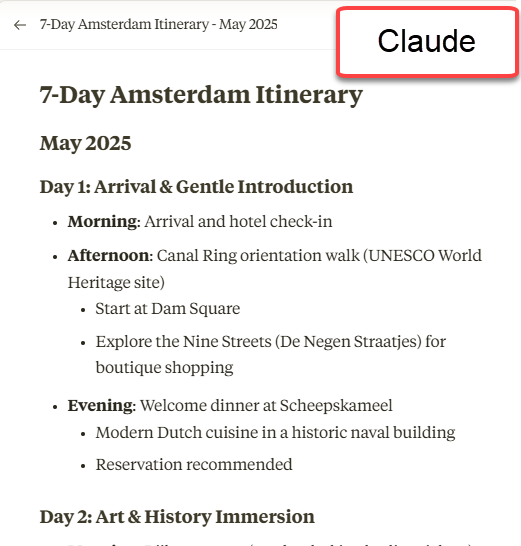
- Claude: Claude provided me with a terrific itinerary. It wasn’t overly booked, but had items for each morning, afternoon, and evening. It kept to my preferences extremely well. When it recommended a cruise, it specified a recommended company. It mentioned when reservations were recommended and the best time of day to visit places. At the end it gave several additional tips, including weather information. Rating: A.
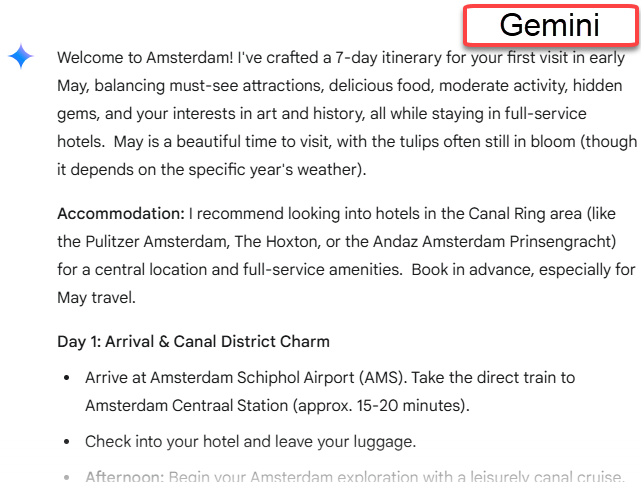
- Gemini: Gemini also did a very good job, also breaking the days down into morning, afternoon, and evening, but adding lunch. At the end, it touched on my requests of food experiences, hidden gems, and added travel notes (languages, transportation, etc.) Rating: A-.
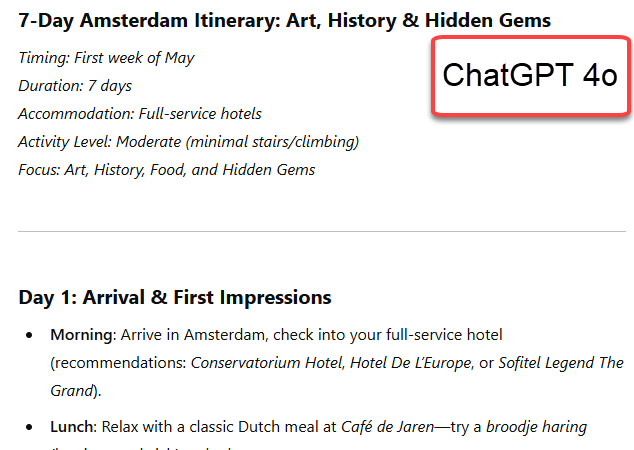
- ChatGPT 4o: Did a similar daily breakdown to the other models. The interesting thing was that it added a day trip out of town, offering options of Utrecht and The Hague. ChatGPT also offered me two different responses and asked which I prefer. I chose the first, for more details, although the second had a map, which was very nice. Rating: A-.
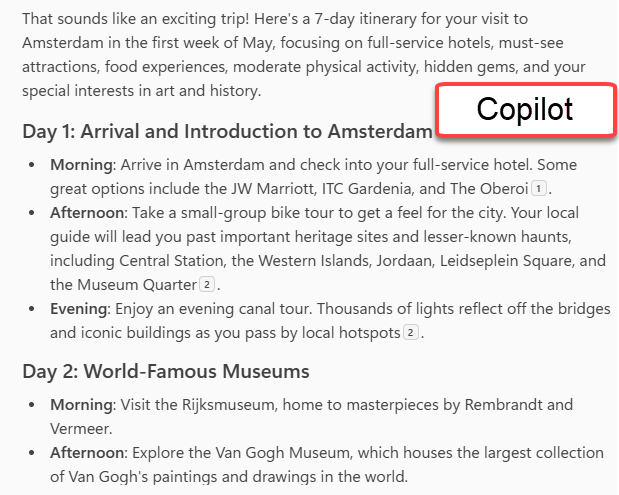
- Copilot: Copilot had some terrific ideas of what to do, but few recommendations. It felt a little bit terse. It added time for souvenir shopping at local markets, which was cool! Though its recommendations all seemed solid, I would say it didn’t have the bonus adds that the others did. Rating: B+.
Caveat: I haven’t been to Amsterdam, so I don’t know how valid the recommendations are, or if the recommended places are closed, for example.
Summary: Only Gemini and ChatGPT incorporated May into the itinerary by mentioning gardens in bloom. Claude did mention May weather and Copilot’s itinerary seemed month-agnostic. They all had themes for each day, which was fun. All of them missed the fact that May 5 is a holiday (Liberation Day).
In the future, I would ask for more info including distances, costs, maps, and perhaps a checklist of all the reservations I’d need to make ahead of time.
Although I’d be happy with any of them for an actual trip, Claude edged the others out this time.
Hands-On Challenge: Try AI for Your Own Travel Plans
Want to see how AI handles your next trip? Here’s your challenge:
- Use ChatGPT, Google
BardGemini, or a dedicated AI trip planner (like GuideGeek or Tripnotes). - Enter your travel details (destination, length of stay, preferences).
- Compare results to traditional guides (Lonely Planet, TripAdvisor, etc.).
- Adjust the itinerary based on what AI suggests—does it get your travel style right?
Share your experience! What worked? What fell flat? Let’s see if AI is ready to take over travel planning.
Final Thoughts: AI as a Co-Pilot, Not the Captain
AI travel assistants are great for inspiration and logistics, but human judgment is still key. Combining AI recommendations with personal research might just be the best approach.
Further Resources
- The New York Times AI travel experiments
- AI-powered itinerary tools to explore (for example, Canva’s AI Trip Planner, mindtrip, AI Travel Agentor Trip Planner AI, though I haven’t tested any of them)
- Best travel guides for deeper insights (for example, Rick Steves, Lonely Planet, Fodor’s)
Some sample outputs:
Disclosure
This post was created with AI assistance and refined with my insights. I take responsibility for all content and personalization.




 janeteblake
Pingback: AI Series 4 Wrap-Up: Practical Use Cases for AI | janeteblake
Pingback: 52 AI Ancestors in 52 Weeks: Week 20: Wheels | janetbgenealogy
Pingback: 52 AI Ancestors in 52 Weeks: Week 28: Travel | janetbgenealogy