
My report from the technical conference.
Our third session on the second day, Wednesday February 24, 2016, was a breakout session, called Microsoft Dynamics AX implementation methodology, with Clay Wesener and Paul Wu, of the SA group.
I hope you can make sufficient sense of my scribbled notes. This was definitely a lot to take in but of course very important. We really need to be comfortable with this. You may have noticed, I’m trying not to infringe on Microsoft’s slide decks, but I think they’re necessary for clarity in this case.
Implementation methodology
There is now a customer LCS project
This is about the tools
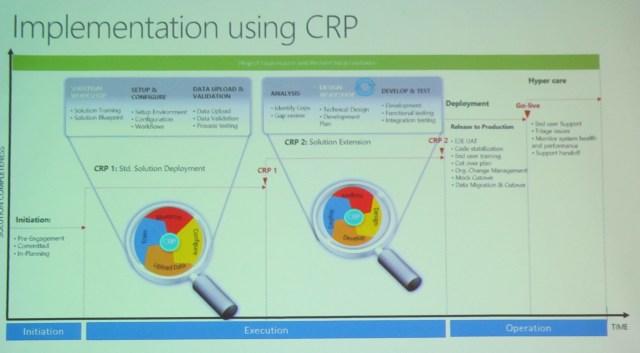
Implementation using CRP
- Smaller iterative approach
- Easier to spin up
- Also see implementation lifecycle workshop
LCS based tooling
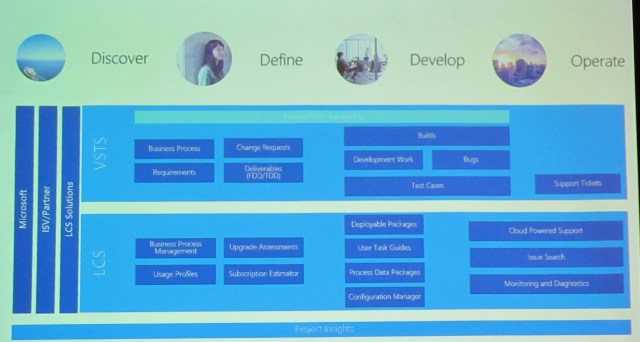
Discover-define-develop-operate
Business process management is much improved – it can support off-AX things
VSTS – business processes, traceability requirements, change requests, deliverables (FDD/TDD), builds, dev work, bugs, test cases, support tickets
LCS – BPM, usage profiles, upgrade assessments, subscription estimate, deployable packages, user task guides, process data packages, configuration manager, cloud powered support, issue search, monitoring and diagnostics
If you get nothing else from this post, then “get” this chart:
Demo: Deploying an environment (Paul Wu)

Demo: BPM and task guides (Clay)
LCS > Business process libraries
You can edit a recording
You get an APQC library with AX
Usage profiles and subscription estimator
LCS > Subscription estimator
Can monitor a VM, but can’t dynamically adjust it
BPM, process data packages (associates DP with a process in your BPM library), configuration Manager
BPM library
You actually load the data into AX from LCS
LCS > Data management
LCS > asset library: you can put in data packages
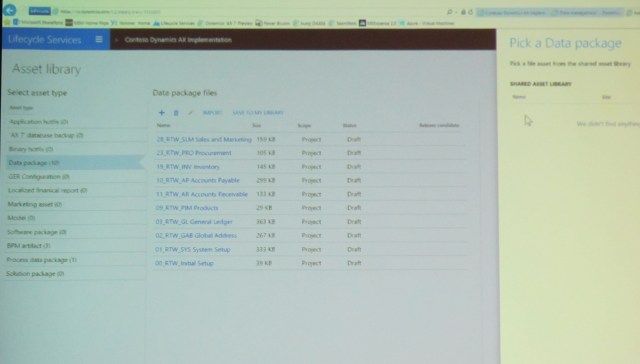
DIXF – configuration manager – process data package
We can specify dependencies (sequences). They advise, not enforce.

TR code gets checked into VSTS
Support and operations demo (Clay)
Happy DAXing!




 janeteblake